Most Phoenix pool owners turn their Phoenix pool heater on in late October or early November, once nighttime lows drop into the 50s and the water falls below about 78 degrees. If you flipped it on this week and nothing happened, you’re not alone. October is the busiest month of the year for heater calls, and most of the time the fix is something simple.
This guide covers when to turn your heater on in the Valley, the difference between a gas heater and a heat pump in our climate, the seven reasons a pool heater won’t fire, and which of those you can safely check yourself before calling for pool repair.
When to turn your pool heater on in Phoenix
The short answer: when the water drops below the temperature you actually want to swim in, which for most people is 80 to 84 degrees. In the Valley that usually happens in late October, and the heating season runs through March or early April.
Phoenix is different from most of the country here. Our summers keep pool water in the mid-80s or higher with no help at all, so the heater sits idle for five or six months. Then the first real cold front rolls through, overnight lows hit the 40s and 50s, and the water can drop 10 degrees in a week. That sudden swing is why so many heaters fail on the first try each fall. They’ve been sitting through a monsoon season of dust, rain and spiders, and nobody has fired them since spring.
A few timing rules that save money:
- Don’t heat the pool in September. The water is still warm and you’ll pay to fight the afternoon sun.
- Turn the heater on a day or two before you plan to swim, not a week early. A gas heater can raise a typical backyard pool 1 to 2 degrees an hour.
- If you only swim on weekends, heat Friday afternoon and let it drift the rest of the week. Holding 82 degrees around the clock in January is the fastest way to a big gas bill.
- A solar cover is the single best thing you can pair with a heater in Phoenix. It cuts overnight heat loss dramatically and keeps dust and debris out.
If you have a spa attached to the pool, the math changes. Spas heat in 20 to 40 minutes and most Phoenix owners run the spa all winter while leaving the main pool cold. That’s a perfectly good strategy and it costs a fraction of heating the whole pool.
Gas heater or heat pump: which one do you have?
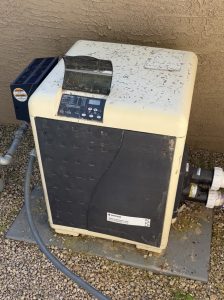
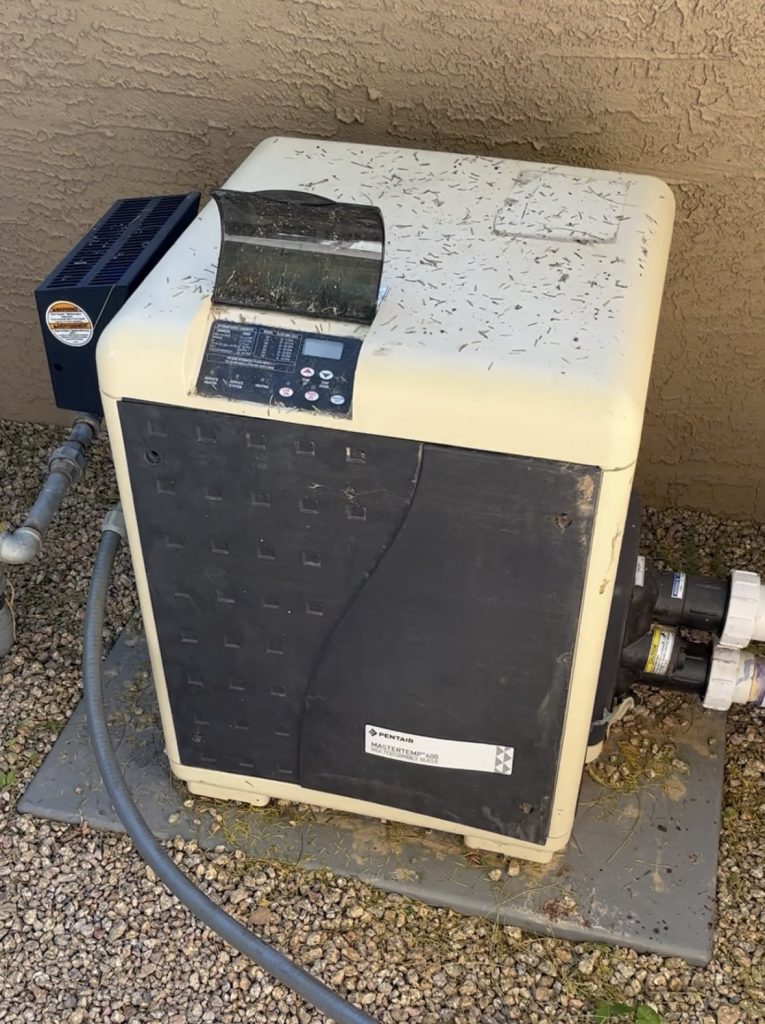
Most Phoenix pools have a natural gas heater. Brands you’ll see on the equipment pad include Raypak, Pentair MasterTemp, Hayward Universal and Jandy JXi. A gas heater makes heat by burning fuel, so it works the same in a 45-degree night as it does on a warm afternoon. It heats fast and it’s the right choice if you want the pool warm on demand.
A heat pump, like a Pentair UltraTemp or Hayward HeatPro, works differently. It pulls heat out of the outside air and moves it into the water, the same way your home AC works in reverse. That makes it far cheaper to run, but it has one weakness that matters in Phoenix: it loses efficiency as the air gets colder. Heat pumps do their best work when the air is above 50 degrees. On a January night in Cave Creek or Anthem, where lows can dip into the 30s, a heat pump slows way down or shuts off to protect itself.
Why this matters for your “won’t fire” problem:
| Gas heater | Heat pump | |
|---|---|---|
| Heats fast | Yes, 1 to 2 degrees an hour | No, slow and steady |
| Works on cold nights | Yes | Struggles below 50 degrees |
| Cost to run | Higher | Lower |
| Common fall failure | Ignition, gas supply, spider webs | Low airflow, freeze sensor, refrigerant |
| Best use in Phoenix | Weekend swimming, spas | Holding a steady temp all season |
If your heat pump “won’t turn on” on a cold morning, it may simply be waiting for the air to warm up. Check the display for a low-temperature or defrost message before assuming it’s broken.
7 reasons your Phoenix pool heater won’t fire
These are the causes we see most, roughly in order of how often they show up on a service call in the north Valley. Start at the top. The first three fix more than half of the no-heat calls we get in October.
1. Low water flow (the most common one)
Every pool heater has a pressure or flow switch that refuses to let it fire unless enough water is moving through it. If your filter is dirty, a skimmer or pump basket is packed with leaves, or a valve is partly closed, the heater sees low flow and does nothing. It’s protecting itself from overheating.
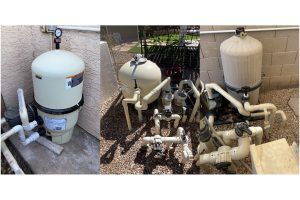
What to check: look at your filter pressure gauge. If it’s 8 to 10 psi above its clean reading, clean the cartridge or backwash the sand or DE filter. Empty both baskets. Make sure the valves feeding the heater are fully open. This one cause explains more fall heater calls than everything else combined, because the filter has been loading up with monsoon dust all summer.
2. The thermostat is set below the water temperature
Simple, but it catches people every year. If the water is 72 and the heater is set to 70, it won’t fire. If the pool and spa share a heater, make sure you’re adjusting the right one.
What to check: set the thermostat at least 5 degrees above the current water temperature and give it a minute. If you have a control system like Pentair IntelliCenter, Jandy iAquaLink or Hayward OmniLogic, also confirm the heater is set to “Heater” or “On,” not “Off” or “Solar.” Automation systems get set to Off in May and forgotten.
3. No gas, or not enough gas
A gas heater needs fuel at the right pressure. The gas valve at the heater or at the meter may have been shut off during summer work. If you’re on propane, the tank may be low. And if someone added a gas fire pit, outdoor kitchen or tankless water heater to the same line, the heater may not be getting enough pressure when other appliances run.
What to check: confirm every gas valve between the meter and the heater is open. On propane, check the tank level. If you smell gas anywhere near the heater, stop, shut off the gas and call a professional. Don’t keep trying to light it.
4. Ignition failure or a dirty flame sensor
Modern heaters use an electronic igniter instead of a pilot light. Igniters wear out, and the flame sensor that confirms the burner lit gets coated with residue. When either one fails, the heater tries to light, gives up and shows an error.
What to check: read the display. On a Pentair MasterTemp the code is ERR IGN. Raypak, Hayward and Jandy heaters show an ignition fault on the display. This MasterTemp error code guide lists every Pentair code and what clears it. A dirty flame sensor can sometimes be cleaned, but a failed igniter is a replacement part. This is usually a service call.
5. Spider webs and dust in the burner
This one is pure Phoenix. Desert spiders love the warm, sheltered tubes of a pool heater that’s been idle since April. By October the burner orifices and pilot assembly can be packed with webs and dust. The gas can’t flow cleanly, the burner won’t light, or it lights with a yellow, sooty flame.
What to check: with the power and gas off, open the front panel and look at the burner tray. If you see webs or heavy dust, it needs to be cleaned out. We do this on nearly every fall heater startup in Cave Creek, Anthem and North Scottsdale. It’s the single most common reason a heater that worked fine in April won’t light in October.
6. A tripped high-limit switch or a closed bypass
Heaters have a high-limit safety that shuts them down if the water inside gets too hot, often because of low flow (see number one). Once it trips, some heaters stay locked out until they’re reset. Older heaters also have an internal bypass valve that can stick closed, which starves the heat exchanger.
What to check: fix any flow problem first, then look for a reset button near the control board. If the heater keeps tripping its high limit, the heat exchanger may be scaled up with calcium, which is a real problem on Phoenix hard water and a repair job, not a DIY fix.
7. An electrical fault, or a heat pump that’s too cold
No power, no heat. A tripped breaker or GFCI, a blown fuse on the control board or a failed transformer will keep a heater dark even when everything else is fine. Monsoon rain also finds its way into control boards and corrodes them.
If you have a heat pump, the cold itself can be the “fault.” Below about 50 degrees the unit may refuse to run or go into defrost. That’s normal behavior, not a breakdown.
What to check: confirm the breaker and GFCI are on. Look for a fuse on the control board. On a heat pump, check the display for a low-ambient or defrost message and wait for the afternoon to warm up before calling it broken.
What you can check yourself, and when to call
A fair amount of this is safe to do on your own. Some of it isn’t.
Safe to check yourself:
- Filter pressure, and cleaning or backwashing the filter
- Skimmer and pump baskets
- Thermostat setting and the heater mode on your control system
- Every gas valve is open, and the propane tank has fuel
- The breaker and GFCI are on
- The error code on the display, so you can tell a tech what it says
- A visual look at the burner tray for webs or dust, with the power and gas off
Call a pool repair tech for:
- Any smell of gas. Shut it off and don’t keep trying to light it.
- Replacing an igniter, flame sensor, pressure switch or control board
- Gas pressure problems or anything involving the gas line
- Cleaning out a burner tray or heat exchanger
- Refrigerant issues on a heat pump
- An error code that comes back after you’ve reset it
- A heater that’s more than 10 to 12 years old and failing repeatedly. At that point you’re deciding between a repair bill and a replacement, and it’s worth having someone run the numbers with you.
One honest note: heater work involves gas and electricity in the same box, next to water. The checks above are low risk. Opening up the gas train or the control board is not. That’s the line.
What it costs to run a pool heater in Phoenix
Rough numbers, because it depends on your pool size, your heater, your gas rate and how warm you keep it. A gas heater holding a typical backyard pool at 82 degrees through a Phoenix winter commonly runs a few hundred dollars a month on the gas bill, and more for a large pool or a higher set point. A heat pump costs noticeably less to run but takes longer to get there.
The set point matters more than people expect. Every degree you add raises the cost, and the jump from 82 to 86 is a lot bigger than it sounds because the heater is fighting more heat loss every night.
Five ways to cut the bill:
- Use a solar cover. This is the big one. Most of a heated pool’s heat escapes off the surface overnight, and a cover stops most of that.
- Heat for the days you swim, not around the clock.
- Set it to 80 to 82, not 86.
- Keep the filter clean so the heater gets full flow and runs efficiently.
- Pair the heater with a variable speed pump. Running the pump at a lower speed for longer keeps water moving through the heater without the big electric bill of a single-speed pump.
If your heater seems to be costing more than it used to, that’s often a sign the heat exchanger is scaling up from our hard water. A scaled exchanger has to burn more gas to move the same heat. It’s worth having it looked at.
FAQs
When should I turn my pool heater on in Phoenix?
Late October or early November for most pools, once nighttime lows drop into the 50s and the water falls below about 78 degrees. The heating season usually runs through March or early April.
Why won’t my pool heater turn on?
The most common cause is low water flow from a dirty filter or full baskets. After that, check the thermostat setting, the gas supply and the error code on the display. In Phoenix, spider webs in the burner are a frequent cause after a summer of sitting idle.
How long does it take to heat a pool in Phoenix?
A gas heater raises a typical backyard pool about 1 to 2 degrees an hour, so a 10-degree increase takes most of a day. A heat pump is slower and works best when the air is above 50 degrees. An attached spa heats in 20 to 40 minutes.
Is it cheaper to leave the pool heater on all the time?
No. Holding a set temperature around the clock costs far more than heating for the days you swim. A solar cover reduces overnight heat loss and is the most effective way to lower the bill.
Can I fix my pool heater myself?
You can safely check the filter, baskets, thermostat, gas valves, breaker and error code. Anything involving the gas line, igniter, control board or heat exchanger should be handled by a licensed pool repair technician. If you smell gas, shut it off and call.
Heater won’t fire? We can help
If you’ve run through the checks above and your Phoenix pool heater still won’t light, that’s what we do. AZ’s Best Pool Service & Repair has been fixing pool heaters in the north Valley since 2002. We’re licensed, bonded and insured (AZ ROC 328190), and we’re certified on Pentair, Hayward and Jandy equipment, so we carry the right parts and know the error codes without guessing.
We service North Phoenix, Paradise Valley, North Scottsdale, Cave Creek, Anthem and Desert Ridge. Most fall heater calls are a same-week fix, and we’ll tell you straight if a repair makes sense or if the heater is at the end of its life.
Call or text (602) 854-8233 for a free estimate, or request one online. And if you’d rather never think about the filter, the baskets or the first cold snap again, ask about weekly pool service. A clean filter is the number one thing that keeps a heater firing.